Lighting Ideas for Double-Height Ceilings
Walking into a room with a double-height ceiling is an undeniable architectural experience. The sheer volume of space creates an immediate sense of grandeur, luxury, and openness. However, that magnificent vertical expanse also presents one of the most complex challenges in interior design: how do you light it properly?
When ceilings soar to 18, 20, or even 25 feet, standard lighting rules no longer apply. Light has to travel much further to reach the floor, which can leave the lower half of the room feeling shadowy or disconnected from the upper half. If you get the lighting wrong, your majestic space can end up feeling like a cold, cavernous warehouse. But when executed perfectly, the right lighting transforms that empty void into a cohesive, breathtaking masterpiece.
Whether you are designing a grand entryway, a palatial dining room, or a contemporary open-plan living area, this guide will walk you through the core principles of illuminating high spaces. We will explore strategic lighting ideas, technical considerations, and highlight some of the most stunning, high-performance fixtures from Ankur Lighting to help you bring your vision to life.

Why Double-Height Ceilings Demand a Unique Approach
To understand how to light a double-height room, we first need to understand the physics and psychology of the space.
The Lumen Drop-Off
Light dissipates as it travels. A standard recessed downlight that provides perfect illumination from a 9-foot ceiling will barely register when mounted at 20 feet. To compensate for this "lumen drop-off," high ceilings require fixtures with significantly higher lumen outputs and tighter beam angles to punch the light all the way down to the living level.
The Visual Void
Human eyes naturally scan a room at eye level (around 5 to 6 feet high). In a double-height room, there is a massive expanse of empty space between eye level and the ceiling. If you only use recessed lights, that middle area remains dark, creating a visual disconnect. You need fixtures that physically occupy that middle space—drawing the eye upward and bridging the gap between the floor and the ceiling.
The Glare Factor
Because you are looking up into a much larger volume of space, the source of the light is more likely to catch your eye. Exposed bulbs or poorly designed downlights at high elevations can cause uncomfortable glare. The solution requires fixtures with deep-recessed light sources or high-quality diffusers.

The Core Strategy: Layering Your Light
The secret to lighting any room—but especially a double-height room—is layering. Relying on a single light source will always result in a flat, uninviting environment. A successful lighting scheme seamlessly blends three distinct layers:
1. Ambient Lighting (The Foundation)
This is your general illumination. In a high-ceilinged room, ambient light is usually achieved through high-powered LED recessed downlights or large architectural ceiling panels. The goal is to provide a base layer of light that allows you to navigate the space safely and comfortably.
2. Task Lighting (The Function)
Task lighting is highly focused illumination directed at specific areas where activities take place. In a double-height living room, this might be a modern floor lamp arching over a reading chair, or targeted track lighting highlighting a coffee table. Because the ceiling is so far away, task lighting is often brought closer to the human level.
3. Accent Lighting (The Drama)
Accent lighting brings the architecture to life. It highlights textured stone walls, towering bookshelves, or large-scale artwork. This layer adds depth, creates shadows, and emphasizes the structural beauty of the double-height space.
Strategic Lighting Ideas to Transform Your Space
Now that we understand the layers, let’s look at the specific design strategies you can use to illuminate that towering vertical space.
The Statement Centerpiece
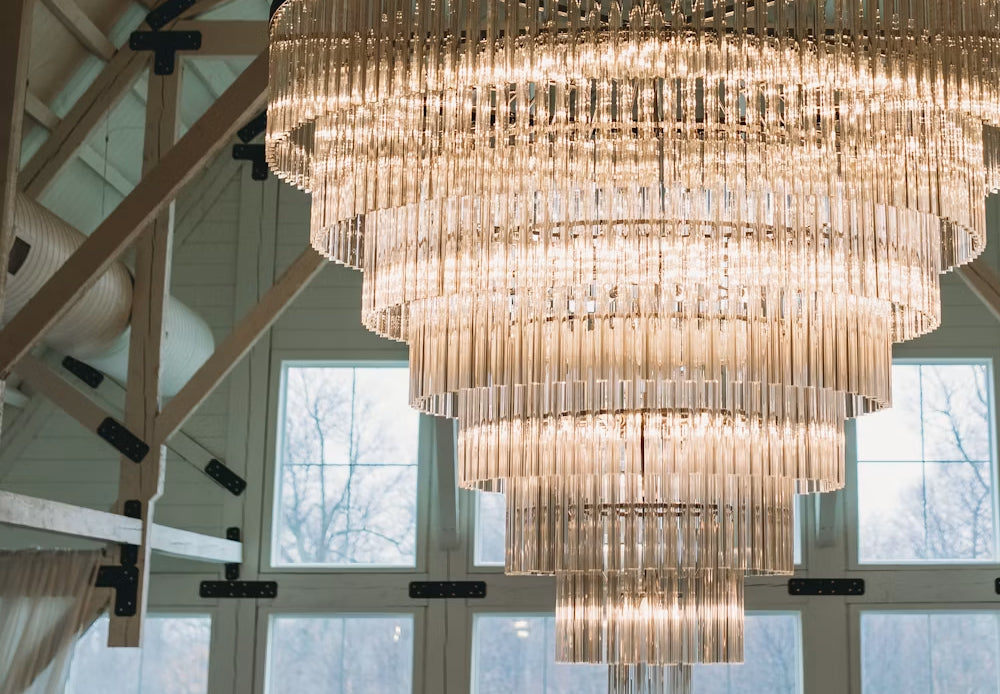
Every double-height room needs a focal point—an anchor that commands attention and fills the upper volume. This is where large-scale chandeliers come into play. A massive crystal chandelier or a sprawling contemporary geometric fixture not only provides ambient light but serves as a piece of suspended sculpture.
The Rule of Thirds
When hanging a central fixture, interior designers often rely on the Rule of Thirds. Mentally divide your vertical space into three equal sections: top, middle, and bottom. The chandelier should ideally sit in the upper portion of the middle third. This ensures it doesn't hang dangerously low, but drops far enough from the ceiling to feel connected to the furniture below.
Cascading Clusters
If a single massive chandelier feels too traditional, consider a cascading cluster of pendant lights. Hanging multiple pendants at varying lengths creates a "waterfall" of light that guides the eye vertically through the space. This is exceptionally effective in tall, narrow spaces like stairwells or small entryways, as it fills the vertical void without requiring a wide footprint.
Architectural Wall Washing
One of the most effective ways to make a tall room feel bright and airy is to light the walls, rather than just the floor. Using adjustable track lights or recessed wall washers to cast light down the full length of a high wall highlights the texture of the paint, wood panels, or stonework, effectively turning the wall itself into a massive, soft light source.

5 Premium Lighting Picks for Double-Height Ceilings
To achieve the perfect balance of luxury, scale, and performance, your fixture selection is critical. Here are five standout products from Ankur Lighting designed specifically to conquer the challenges and elevate the aesthetics of double-height spaces.
1. The Architectural Anchor: Ankur Fulgurite Crystal Double Height Modern Chandelier
When you have a grand entryway or a luxury living room that demands absolute opulence, the Fulgurite is the answer. This chandelier is specifically scaled for double-height spaces. It features a dramatic, elongated design that pairs the timeless sparkle of intricate crystal glass with a warm, modern antique brass metal frame.
Why it works for high ceilings: It fills the visual void beautifully. The heavy crystal components ensure that the light reflects and refracts throughout the upper space, creating a dazzling play of light and shadow on your tall walls.
-
Explore the product here: Ankur Fulgurite Crystal Double Height Modern Chandelier
2. The Vertical Illusion: Ankur Modern Smoke Crown Multilayer Crystal Chandelier
If your interior design leans more towards contemporary moodiness, this fixture is an absolute showstopper. Available in towering 6-foot and 8-foot variants, this multilayered masterpiece uses a combination of smoky and clear glass to create a dramatic, tiered lighting effect.
Why it works for high ceilings: The sheer vertical length of the 8-foot variant physically connects the upper and lower halves of a room. It draws the eye all the way up, emphasizing the height of the ceiling while keeping the light source close enough to the living space to provide substantial ambient illumination.
-
Explore the product here: Ankur Modern Smoke Crown Multilayer Crystal Double Height Chandelier
3. The Sculptural Statement: Ankur Geom Tangled Contemporary LED Pendant Chandelier
Modern design is often about breaking the rules of symmetry, and this fixture does exactly that. The Ankur Geom Tangled Pendant is a masterful piece of contemporary art, available in stunning gold and rose gold finishes. Its intricate, intersecting geometric lines cast a captivating, organized chaos of light.
Why it works for high ceilings: High ceilings give you the room to be bold. Because this fixture is wide (400mm) and long (1300mm), it has the scale required to not get lost in a large room. It acts as a hovering sculpture that provides brilliant ambient LED light while serving as the ultimate conversation starter.
-
Explore the product here: Ankur Geom Tangled Contemporary LED Pendant Chandelier
4. The Architectural Accent: Ankur 5mm Nanoslim Magnetic Adjustable Track Spot Light
A double-height room isn't just about the chandelier; you need to highlight the architecture. This ultra-minimalist, 5mm slim magnetic track system is the cutting edge of modern lighting. It allows you to snap adjustable LED spot modules directly into the ceiling or run them vertically down a wall.
Why it works for high ceilings: Precision. When you need to push a tight beam of light 20 feet down to highlight a dining table, or angle a spot to wash a towering textured wall, these magnetic spots deliver. You can choose between 3000K, 4000K, and 6500K color temperatures, giving you total control over the mood of the room.
-
Explore the product here: Ankur 5mm Nanoslim Magnetic Adjustable and Modern Magnetic Track Spot Light
5. The Flawless Foundation: Ankur Euro Bar Recessed LED Downlight
Your ambient lighting needs to be powerful, but invisible. The Ankur Euro Bar is the epitome of sleek sophistication. It is a recessed downlight that offers clean lines, a modern feel, and most importantly, deep anti-glare properties.
Why it works for high ceilings: When looking up into a high ceiling, exposed bulbs cause massive eye strain. The deeply recessed design of the Euro Bar ensures that the light source is hidden from natural viewing angles, providing smooth, powerful ambient light all the way to the floor without blinding anyone looking upward.
-
Explore the product here: Ankur Euro Bar Recessed LED Downlight
Pro Tips: Installation and Maintenance Considerations
Lighting a double-height space isn't just a design challenge; it is a logistical one. Before you purchase and install, keep these critical factors in mind.
1. Plan for Maintenance Early
Changing a light bulb at 20 feet is not a simple Saturday morning chore; it often requires scaffolding or a specialized A-frame ladder. To minimize this headache, always invest in high-quality, integrated LED fixtures (like those from Ankur Lighting) that offer a lifespan of 30,000 to 50,000 hours. For massive, heavy chandeliers, consider installing a motorized winch system during construction. This allows you to lower the fixture to the floor with the push of a button for effortless cleaning and maintenance.
2. Consistency in Color Temperature
In a massive space, mismatched light colors will instantly ruin the luxurious feel. Ensure all your layers—from the high-ceiling recessed lights to the cascading chandelier—share the same color temperature. For residential living spaces, a warm 3000K is ideal for creating a cozy, inviting atmosphere, while 4000K works beautifully for sleek, ultra-modern or commercial spaces.
3. Invest in Dimming Systems
A double-height room needs to be versatile. The bright, 100% output required for a large evening gathering will feel overwhelmingly stark if you are just trying to watch a movie. Ensure your statement chandeliers and downlights are dimmable and integrated into a smart home system or the Ankur BrightSync App, allowing you to scale the grandness of the room to match the intimacy of the moment.
Conclusion
A double-height ceiling is a blank canvas of immense proportions. While the vertical space can seem intimidating to design around, the right lighting strategy turns it into your home's most impressive asset. By understanding the physics of light drop-off, layering your ambient and accent lighting, and choosing masterfully crafted, scale-appropriate fixtures, you can create an environment that feels both boundlessly grand and warmly inviting. Remember, in a room this large, the lighting isn't just illuminating the design—it is the design.
Frequently Asked Questions (FAQs)
1. How large should a chandelier be for a double-height ceiling?
Scale is everything. A standard rule of thumb is to add the dimensions of your room together in feet, and convert that number to inches for the chandelier's diameter (e.g., a 20ft x 20ft room = 40 inches). However, for double-height spaces, you often need to go larger. Look for fixtures that are at least 36 to 48 inches in diameter, or opt for cascading vertical designs that are 6 to 8 feet in length.
2. How far down should a chandelier hang in a 20-foot room?
While standard 8-foot ceilings require fixtures to hang 7 feet above the floor, double-height spaces follow different rules. Ideally, the bottom of the fixture should sit somewhere between 8 to 10 feet off the floor. If it is hanging over a dining table, the bottom of the fixture should be about 36 to 40 inches above the tabletop.
3. Do I need special recessed lights for a high ceiling?
Yes. Standard recessed lights have wide beam angles that disperse light too quickly, causing it to fade before reaching the floor. For ceilings over 12 feet, you need narrow beam-angle downlights (between 15 to 30 degrees) with higher lumen outputs to "punch" the light down to the living level. Deep-baffle or anti-glare designs are also highly recommended.
4. Can I use magnetic track lighting on a double-height ceiling?
Absolutely. Minimalist magnetic track systems, like the Ankur 5mm Nanoslim, are excellent for high ceilings because they allow you to attach high-powered spot modules. You can aim these spots precisely to wash tall architectural walls, highlight artwork, or illuminate seating areas far below.
5. How do I maintain and clean lights hanging at 20 feet?
For heavy chandeliers, installing a motorized chandelier winch during construction is the safest and easiest method, allowing you to lower the fixture to the floor. If a winch isn't possible, you will need a specialized extension ladder, a telescoping dusting pole, or scaffolding for deep cleaning. To minimize bulb replacements, strictly use long-lasting LED fixtures.
Read more

The Cost Savings of LED Lighting: A Comparative Analysis
In today's world, where energy efficiency and cost-effectiveness are paramount, the shift towards LED lighting has become increasingly evident. Businesses and homeowners alike are realizing the s...
Read more
The Ultimate Guide to Dining Room Lighting
The dining room is more than just a place to eat. It is the heart of the home where families gather, friends celebrate, and memories are made. Whether you are hosting a formal dinner party, enjoyin...
Read more